
The Roadmap Handoff Problem: Why Strategy Alone Fails
Why transformation leaders need partners who stay accountable from strategy through measurable execution.
A global rental car MNC paid a strategy consultancy tens of millions of dollars. What they got back was a lawsuit, with $32 million in claims after a failed website transformation marked by minimal due diligence, full outsourcing without oversight, and a timeline completely misaligned to actual complexity. The project collapsed. The consultants moved on. The enterprise was left holding the damage. This is an extreme version of a pattern that plays out quietly across enterprises every year. Boards approve transformation budgets. Consultants produce polished roadmaps. Delivery stalls. Capabilities do not transfer. And the Head of Technology fields questions at the next board meeting about why nothing has shipped. Strategic accountability in most digital transformation engagements ends at the PowerPoint.
The Roadmap Handoff Problem: Why Strategy Alone Fails
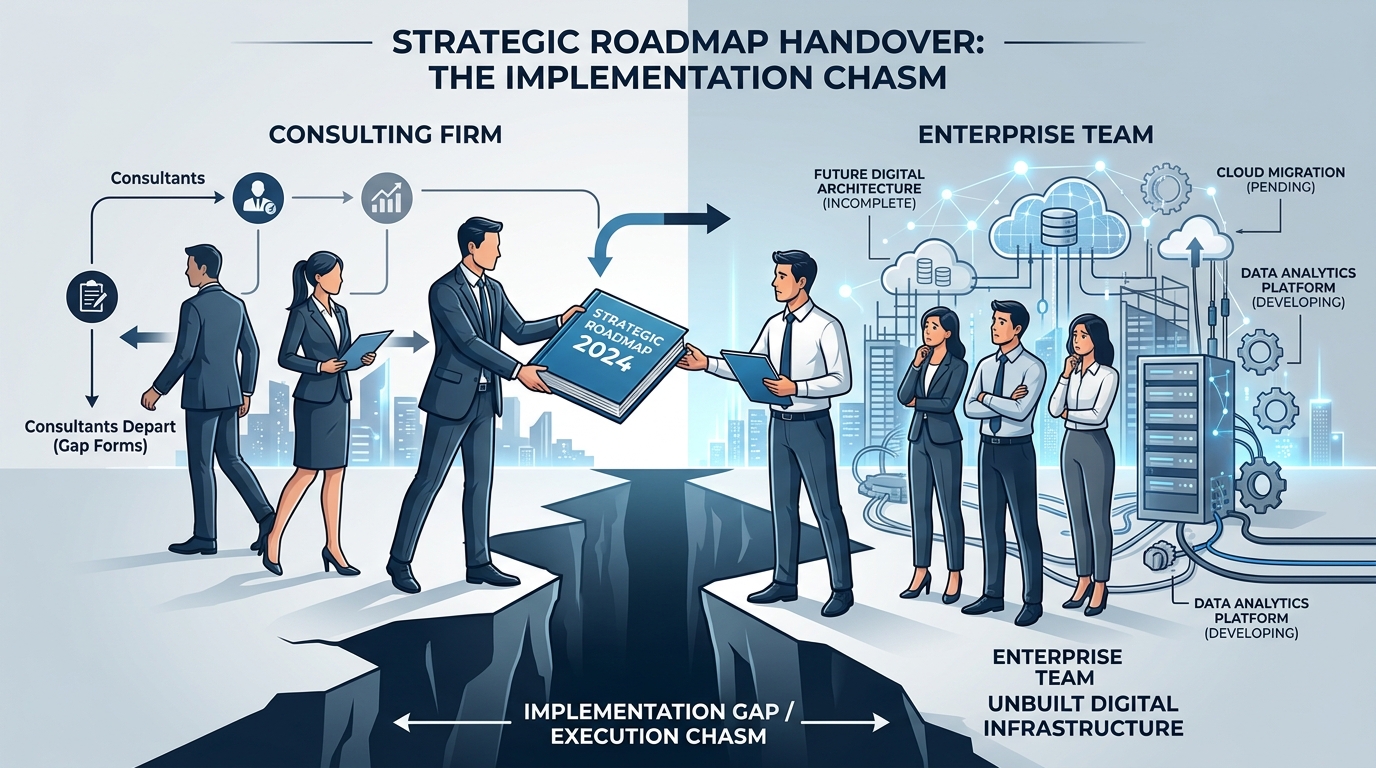
How the industry's 70% failure rate traces to execution gaps, not planning flaws
Analysis by leading global strategy firms is blunt: 70% of digital transformations fail to meet target outcomes. Fewer than 16% sustain improved business performance over time. These are execution failures, including gaps in legacy complexity, data quality, and organizational capability that surface only during implementation, not problems that planning engagements can prevent.
The roadmap handoff happens when a consulting firm completes its strategic deliverable, such as the architecture assessment, transformation blueprint, or phased roadmap, and exits the engagement. What they leave behind is often technically correct but organizationally unsupported. The client internal team, frequently without the engineering depth or change management expertise to execute, is expected to translate strategy into shipped software on its own.
fail to meet target outcomes, while fewer than 16% sustain improved business performance over time.
Why consultants disappear post-delivery and leave you bridging the capability gap
This reflects how the engagement model is structured. Most digital transformation consulting engagements are scoped to strategy or assessment phases, with execution treated as a separate procurement. The firm that built the roadmap often has limited commercial incentive to stay through the hard part, including legacy migration, team reskilling, and organizational resistance that spikes when new processes touch people daily work.
Industry research from technology leadership studies identifies the non-technical root causes of transformation failure consistently: resistance to new working methods, change fatigue, and lack of skill development inside the client organization. These are exactly the problems that a consultant who exits at the roadmap stage cannot solve. They require ongoing presence, embedded expertise, and someone with accountability for what happens after the deck is delivered.
Real costs of misalignment: a cautionary tale from a global enterprise lawsuit
The rental car MNC case is the most publicized, but the pattern is common. When strategy and execution are owned by different parties, or when the executing party has no stake in the outcome, accountability becomes a coordination problem. Milestones get declared complete based on deliverable submission, not business impact. The client discovers the gap when they try to operate what was built and find it does not match what was promised.
For Heads of Technology fielding board pressure on transformation timelines and ROI, this gap is the central risk. The critical question is whether they will be accountable when strategy meets the reality of legacy systems, organizational culture, and existing team capacity.
How Industry Leaders Address Accountability: Integrated Delivery Firms
Integrated delivery arms that pair strategy with execution
The firms that consistently appear in top industry analyst rankings share a structural characteristic: they do not separate strategy from delivery. One global consulting MNC integrates cloud, AI, and automation with functional transformation through a Digital Core platform, reinforced by agile, DevOps, and standardized governance structures. Strategy and execution live in the same engagement model.
A global technology services MNC serving 75% of the Fortune Global 100 operates a four-stage reinvention strategy spanning from initial planning through the establishment of new operational models. A 2023 consolidation brought four acquisitions under a single delivery identity, specifically to close the gap between strategy design and execution capacity.
An integrated digital delivery firm runs a structured framework built around 90-day cycles from customer discovery to proof of concept, with security, compliance, and rapid feedback integrated from the start. Its consulting methodology is client-centric and governance-focused, aligning architectural designs and optimization roadmaps to each organization regulatory environment and long-term technology strategy, not just to an ideal-state blueprint.
Explicit KPI co-ownership and outcome measurement before, during, and after launch
What separates these firms is their willingness to co-own metrics, meaning they accept accountability for business outcomes, not just deliverables. Industry analyst peer review ratings highlight buyers rating these firms highly specifically for the appropriateness and execution of their delivery models and customer service capability. That language describes sustained engagement, not a one-time handoff.
Co-owning KPIs means being on record before work begins about what success looks like, and remaining accountable through the period when those metrics become measurable. This is a commercial risk that planning-only firms routinely avoid by scoping their deliverables to documentation rather than outcomes.
Governance structures and certifications that enforce rigor
Certifications like scaled agile frameworks, IT service management standards, and information security standards exist precisely to create external accountability structures. Leading firms hold top-tier partnership status from agile governance bodies. Integrated delivery firms operate IT service management practices embedded in their digitalization delivery model. These are not marketing badges. They represent documented, auditable delivery processes with defined governance gates.
Firms without equivalent certifications or published delivery frameworks are asking clients to trust execution capability on faith. At enterprise scale, that is not a reasonable ask.
Integrated Delivery Firms vs. Planning-Only Consultants: What Really Differentiates
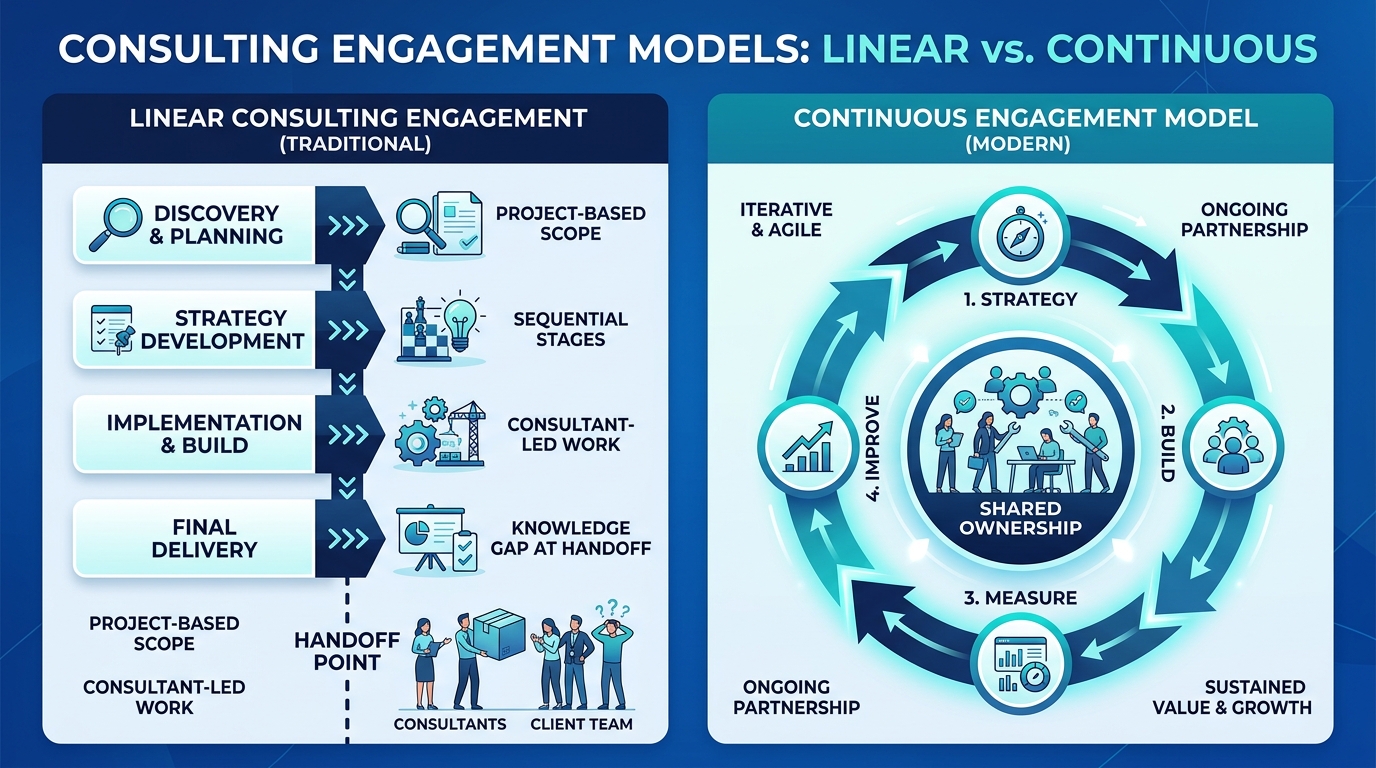
Execution transparency: 90-day Launchpad with governance vs. generic roadmaps
An integrated delivery firm 90-day AI Launchpad is a specific, structured program with defined phases, governance checkpoints, and a deliverable that is a working proof of concept, not a document recommending that a proof of concept be built. This is the difference between a roadmap that says evaluate AI use cases and an engagement that produces a running AI system within a defined timeframe.
The specificity matters for procurement. When you know exactly what a 90-day engagement includes, what governance gates exist, and what the exit criteria are, you can evaluate whether the vendor methodology matches your actual complexity. Generic transformation roadmaps do not offer this. They produce plans shaped more by consultant templates than by operational reality.
Post-launch ownership: managed services and continuous improvement vs. handoff
Integrated delivery firms pair strategic consulting with ongoing managed services, which means the same firm that designed the architecture can be contractually accountable for operating it. This is a fundamentally different risk profile than engaging a strategy firm and then separately procuring a systems integrator to execute its roadmap.
For the enterprise buyer, managed services with outcome-linked SLAs create a situation where the vendor commercial interest is aligned with operational success. Firms that exit after strategy delivery have no such alignment. Their revenue is captured at the roadmap handoff, regardless of whether the transformation succeeds.
Scope clarity and risk allocation: who owns delivery failure and remediation?
When a transformation fails or stalls, and the base rate for partial failure is high, the critical question is who is responsible for remediation. In a handoff model, the answer is almost always the client. The consulting firm has fulfilled its contractual scope. The execution partner, if there is one, may dispute whether the strategy they received was implementable.
Integrated partners who carry accountability through delivery have a different answer: they own remediation because they own the outcome. This creates selection pressure within the vendor organization to scope engagements honestly, flag complexity early, and build delivery teams with the actual skills to execute what the strategy prescribes.
If this does not ship on time, or does not perform as projected, who is financially and operationally responsible for fixing it?
The question every Head of Technology should ask a transformation partner
The Hidden Costs of Consultant Disappearance
Organizational and cultural resistance spike without ongoing sponsorship
The hardest part of digital transformation is people, according to analyst consensus and practitioner evidence. Resistance to new working methods, change fatigue, and lack of internal skill development are primary drivers of transformation failure, according to industry research from global strategy firms.
These problems do not surface during strategy design. They surface at month four of implementation, when the new platform requires people to change workflows they have used for a decade, and no one from the consulting firm that built the case for change is present to support adoption.
Executive sponsorship maintained through delivery, not just planning, is what separates transformations that stick from those that stall. When the transformation partner is still in the room during the difficult adoption period, they can adjust the approach, facilitate executive communication, and prevent organizational resistance from derailing an otherwise technically sound program.
Knowledge gaps leave teams unable to maintain what was delivered
Even when technology is delivered successfully, a handoff model creates a sustainability problem. If the consulting firm built a custom data pipeline, new microservices architecture, or AI inference layer and then exits, the internal team inherits a system they did not build and may not fully understand.
Knowledge gaps have a compounding cost. When the system needs to evolve, and in technology it always does, the team either reconstructs institutional knowledge that should have been transferred or re-engages the original vendor at premium rates. Neither outcome reflects well on the original engagement model.
Knowledge must transfer actively through collaboration, not through documentation dumps at project close. Partners who value the ongoing relationship build internal capability alongside delivery. That is what makes transformation durable rather than a one-time event.
Board accountability stalls without shared KPI ownership
The board does not care about deliverables. It cares about outcomes. When a transformation initiative stalls between strategy and execution, the Head of Technology is left explaining variances against metrics set during the strategy phase, metrics the consulting firm may no longer be tracking or accountable for.
Only 35% of transformations succeed by outcome measures, according to market research data and global strategy firm analysis. The failures trace consistently to poorly defined responsibility for implementation and initiative overload. When accountability is explicit, contractual, and tied to specific metrics, both vendor and client have a shared incentive to solve execution problems rather than explain them.
Market Trends: Why Accountability Demand Is Rising
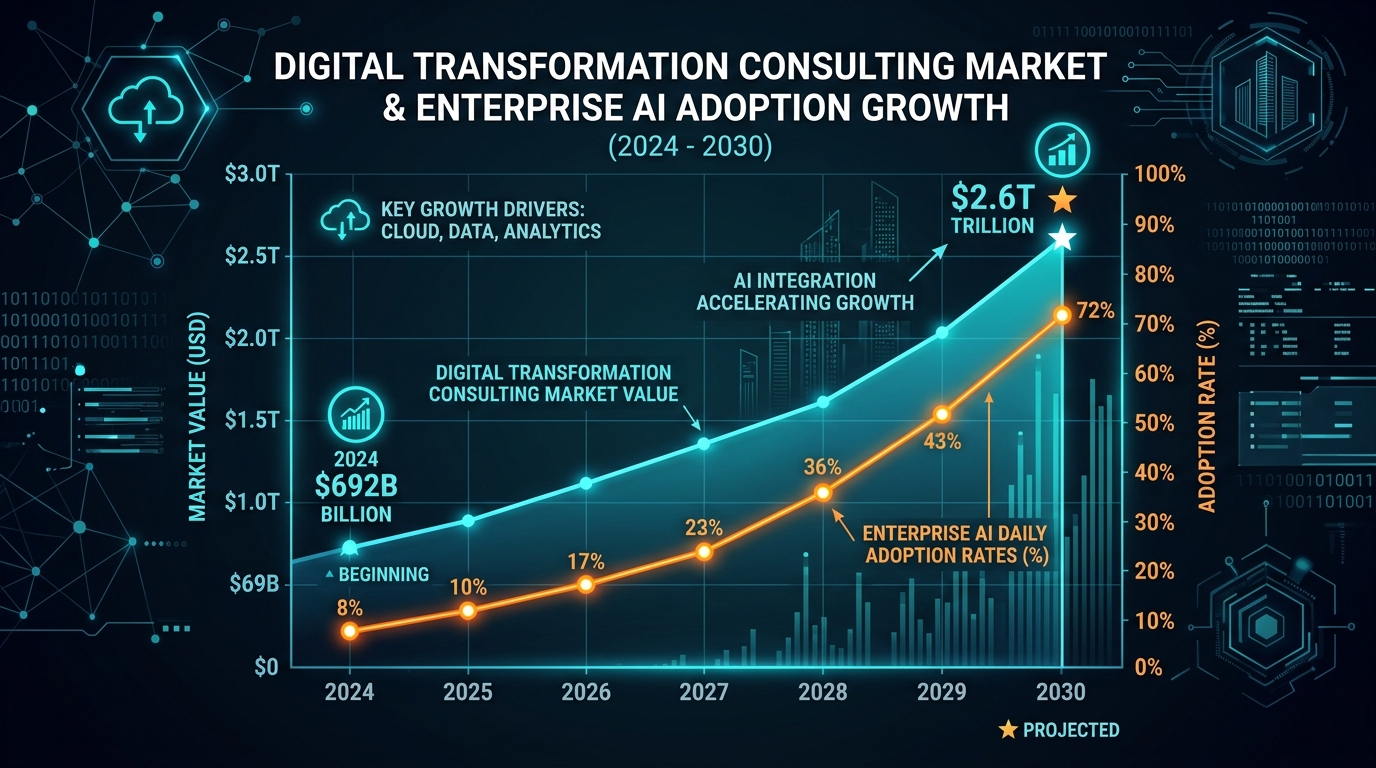
A $692 billion market growing toward $2.6 trillion with rising scrutiny
The global digital transformation consulting market was estimated at $692.3 billion in 2025 and is projected to reach $2.6 trillion by 2035, with a compound annual growth rate of 14% to 19% depending on segment, according to market research firms. North America is expected to capture approximately 39% of that market.
At this scale, accountability becomes a procurement imperative rather than a differentiator. When transformation budgets run into the tens or hundreds of millions, tolerance for execution gaps narrows dramatically. Boards are asking harder questions. Procurement teams are demanding outcome-linked contracts. Enterprise buyers who have survived one failed transformation are far more skeptical of planning-only engagements the second time around.
Enterprise AI adoption has raised the execution bar
Central bank economic data shows that by the end of 2025, 59% of large enterprises reported daily operational AI use, and 96% of those saw measurable business value. That is a striking success rate, but it applies only to firms that successfully operationalized AI, not those that commissioned an AI strategy and then could not execute it.
The AI transformation landscape rewards speed and execution rigor. A 90-day proof of concept that becomes a production system creates competitive advantage. A 90-day AI assessment that produces a roadmap for future consideration does not. As AI capability becomes central to enterprise competitiveness, pressure on digital transformation companies to deliver working systems, not just strategies, will only increase.
Analyst and investor attention is shifting toward delivery-first vendors
Leading global consulting MNCs maintain their position in top industry analyst rankings specifically because they demonstrate delivery capacity alongside strategic capability. Integrated delivery firms have been recognized on industry solution provider lists, regional AI excellence rankings, and as cloud platform AI partners, recognitions rooted in execution outcomes rather than planning quality.
The market signal is consistent: recognition and enterprise trust follow demonstrated delivery, not strategic positioning. For closing the strategy-to-execution gap, the standard is clear. Execution credentials must be auditable, not claimed.
How to Evaluate Transformation Partners: The Accountability Checklist
Demand transparent, documented delivery frameworks, not just strategic positioning
Every major firm in this space publishes its delivery methodology. These are named, documented frameworks with defined stages, governance gates, and outcome criteria. Ask any prospective transformation partner to show you the equivalent documentation.
If they cannot produce a published methodology, or if their process description is generic enough to apply to any client in any industry, that is a signal. Documented frameworks create auditability. They allow you to evaluate whether the proposed process matches organizational complexity and regulatory environment. Firms without them are asking you to trust execution capability based on relationship and reputation alone.
Verify execution credentials through analyst rankings and third-party reviews
Analyst recognition in top industry rankings is not a vanity metric. It requires demonstrable delivery capability and client-validated outcomes. Peer review platforms and industry analyst evaluations provide third-party evidence of both what firms deliver and where they fall short.
When a prospective partner lacks third-party recognition or verifiable client feedback, the absence is informative. At enterprise scale, successful delivery generates evidence. Firms with consistent delivery records accumulate testimonials, case studies, analyst citations, and peer references. Those without them may lack the track record to generate that evidence.
Insist on explicit post-strategy support: managed services, KPI co-ownership, and shared risk
Push every prospective partner on what happens after the strategy is delivered. Ask who owns the KPIs that justify the transformation budget, what contractual mechanism exists for remediation if those KPIs are not met, whether managed services keep the same team accountable post-launch, and what knowledge transfer to the internal team looks like and how it is measured.
Partners who can answer these questions with specificity, named roles, defined SLAs, and documented processes are operating a different model from those who treat post-strategy support as a separate optional procurement.
Ask for peer references from enterprise clients 18 or more months into the relationship
The most reliable evidence of accountability is a client that engaged a firm for transformation work and has continued to work with it. The staying power of the relationship is the signal. Firms whose clients consistently re-engage for subsequent phases, or maintain ongoing managed services relationships, have demonstrated that execution quality justifies continued accountability.
References from clients who completed a strategy phase and then disengaged should prompt follow-up questions about why the relationship ended at that point.
From Roadmap to Shipped Product: Why Strategy-to-Execution Integration Wins
The data is unambiguous. Fewer than 16% of digital transformations sustain improved business performance when post-launch accountability is absent. The 70% failure rate is not a planning problem. The plans are often technically sound. It is an execution accountability problem, and it persists because the industry has structured itself to profit from planning.
Integrated transformation partners change this calculus by keeping the same team accountable through delivery. Cultural and technical transformation happen in parallel, not sequentially. When the firm designing your AI architecture is also the firm building it, operating it, and co-owning performance metrics, incentives align. It cannot design something undeliverable and hand it off as someone else problem.
Continuous improvement cycles compound the value. Rather than a one-time transformation event followed by organizational drift, integrated partners build feedback loops, including post-launch measurement, quarterly improvement sprints, and ongoing skill development, that keep the transformation current as technology and business conditions evolve. This is how the firms that make it into the 16% of sustained success stay there.
The selection question for any Head of Technology evaluating digital transformation companies is not which firm produces the best strategy deck. It is which firm will still be accountable for outcomes twelve months after it first presented that deck. That accountability, or its absence, is what separates transformation from expensive planning.
Key Takeaways
- The roadmap handoff separates strategy from the difficult work of implementation, leaving clients accountable for execution gaps.
- Transformation partners should co-own measurable outcomes, not only produce documentation and recommendations.
- Embedded expertise, active knowledge transfer, and post-launch support are essential to durable transformation.
- Governance frameworks, certifications, published methods, and third-party references make execution capability auditable.
- Enterprise buyers should ask who owns remediation when delivery misses its timeline, budget, or performance targets.
- The strongest partners keep the same accountability through strategy, build, launch, operations, and continuous improvement.
Hiring Insights 2026
The strategic shifts reshaping how enterprises source, build, and deploy talent in a capability-driven market.
GCCs and Their Impact on Hiring
How Global Capability Centers are rewriting the rules of talent acquisition, workforce planning, and organizational design.
Talent vs. Opportunities
Why the traditional talent market is inverting and what enterprises must do when opportunities outnumber the people who can deliver them.
The Big Picture of GCCs in AI-Driven Businesses
How Global Capability Centers are becoming the AI-powered engines of enterprise transformation - and what it takes to build one that matters.
Zero Trust Architecture: An Enterprise Guide
Why "never trust, always verify" has become the foundational security model for modern enterprises and how to implement it without paralysing your business.
Ransomware Protection Strategies for 2026
How ransomware has evolved from opportunistic extortion to industrialised crime and the defence-in-depth strategies enterprises need to survive.
Cloud Security Misconfigurations: The Silent Threat
Why the most common cloud breach is not a hack but a misconfiguration and the governance, tooling, and culture that prevents it.
AI in Cybersecurity: Threats, Defences, and the New Battlefield
How artificial intelligence is arming both attackers and defenders and why the organisation that integrates AI into security first will win.
Building a Cybersecurity Capability from Scratch
A practical framework for enterprises that need to move from ad-hoc security tools to a structured, staffed, and sustainable security function.
Why Trusted AI Is the Need of the Hour
As AI moves from pilot to production, trust is becoming the single factor that determines whether AI delivers value or creates catastrophe. Here is why trusted AI is no longer optional and what enterprises must do to build it.
Platform Modernization: From Pilot to Production
Why 80–95% of enterprise AI pilots never reach production - and the architectural, governance, and operational changes that close the gap.
The Pilot-to-Production Crisis: Why Most Enterprise AI Never Ships
Only 14–25% of AI pilots scale to production. The problem is not the models - it is the product engineering function around them. Here is how to fix it.