The Pilot-to-Production Crisis: Why Most Enterprise AI Never Ships
Only 14–25% of AI pilots scale to production. The problem is not the models - it is the product engineering function around them. Here is how to fix it.
Only 14–25% of pilots scale to production. That number has been cited enough times that it has started to feel abstract, but run the math against your own portfolio and it sharpens fast. Enterprises globally are spending $247 billion on AI in 2026, up 64% year-over-year. And yet only 7% have achieved full enterprise-wide scale. Less than 6% realize measurable, company-wide profit from their AI investments. The projects are not failing because the models are bad. They are failing because the organizations around the models are not built to ship.
The pilot-to-production gap is structural, not technical. AI initiatives fail because of fragmented data, unclear ownership, and immature processes - not model quality. Closing the gap requires building a product engineering function with the right roles, processes, and metrics. The organizations that ship AI consistently are the ones that built that function deliberately.
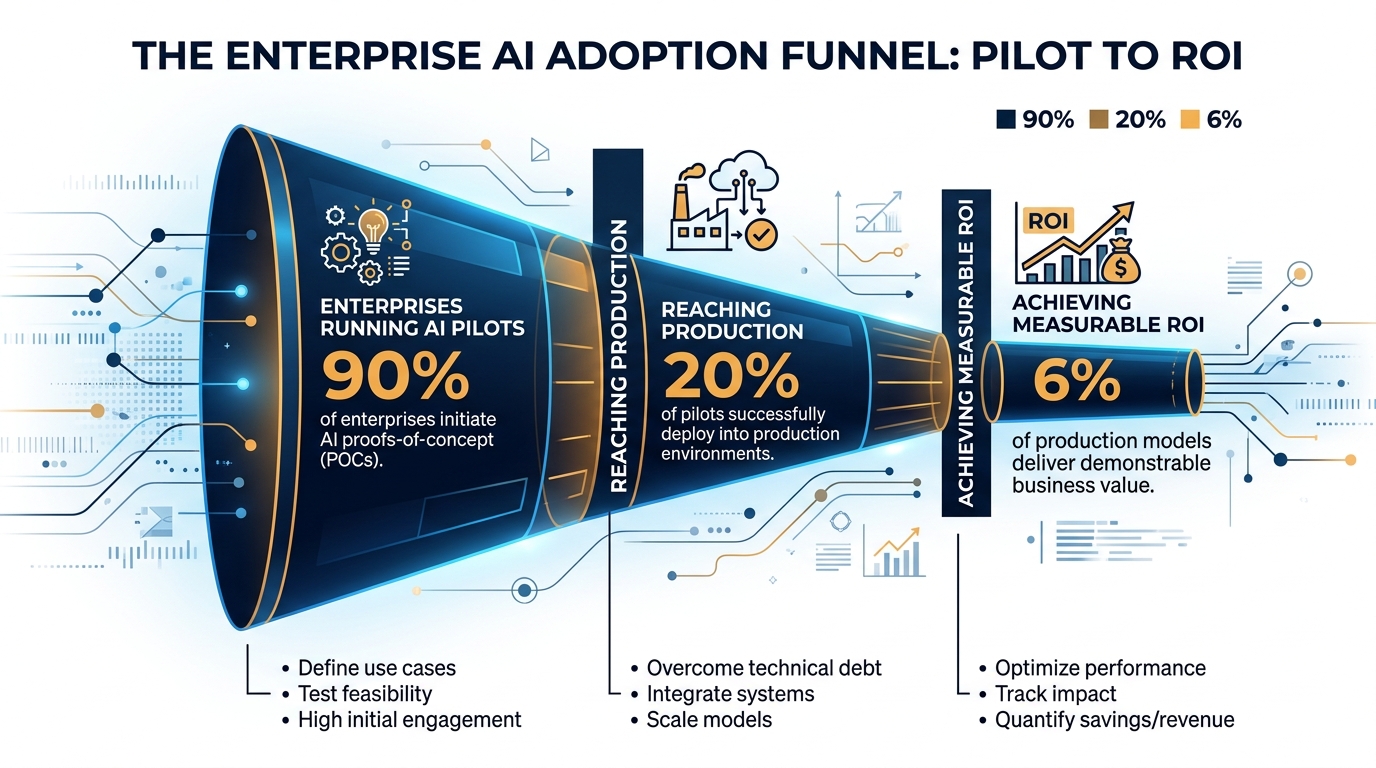
Enterprises globally are spending $247 billion on AI in 2026, up 64% year-over-year. And yet only 7% have achieved full enterprise-wide scale. Less than 6% realize measurable, company-wide profit from their AI investments. The projects are not failing because the models are bad. They are failing because the organizations around the models are not built to ship.
The Real Shape of the Problem
The failure pattern is structural, not technical. Research confirms the root causes cluster around three areas: fragmented data, unclear ownership, and immature processes. Model quality ranks well down the list.
AI initiatives rarely fail because of model quality. Pilots are designed for isolation. Enterprise AI is designed for integration... The model rarely breaks, but the invisible infrastructure around it fails under real-world pressure.
That framing matters. It means your product engineering function, not your data science team, is the critical variable. And most organizations have not built that function deliberately.
Why Pilots Are Engineered for Failure from the Start
Pilots optimize for learning, not for integration. They run on curated datasets, controlled environments, and heroic individual effort. They succeed by being isolated from the complexity of production. That isolation is exactly what makes them fail when someone tries to scale them.
The governance numbers tell the story. 76% of enterprises have adopted formal AI ethics policies. Only 9% document model data lineage. Only 2% log incidents. You can have a policy framework and almost no operational discipline simultaneously, and most organizations do.
55% of companies cite weak MLOps as their primary deployment obstacle. The discipline required to move from a working pilot to a stable, monitored, integrated production system is a product engineering problem.
The discipline required to move from a working pilot to a stable, monitored, integrated production system is a product engineering problem. It requires different roles, different processes, and a fundamentally different culture than running experiments.
For a detailed look at the platform modernization decisions that underpin this shift, see our analysis of moving AI from pilot to production and the infrastructure choices that determine whether pilots escape the lab.
Core Roles That Production-Ready Product Engineering Requires
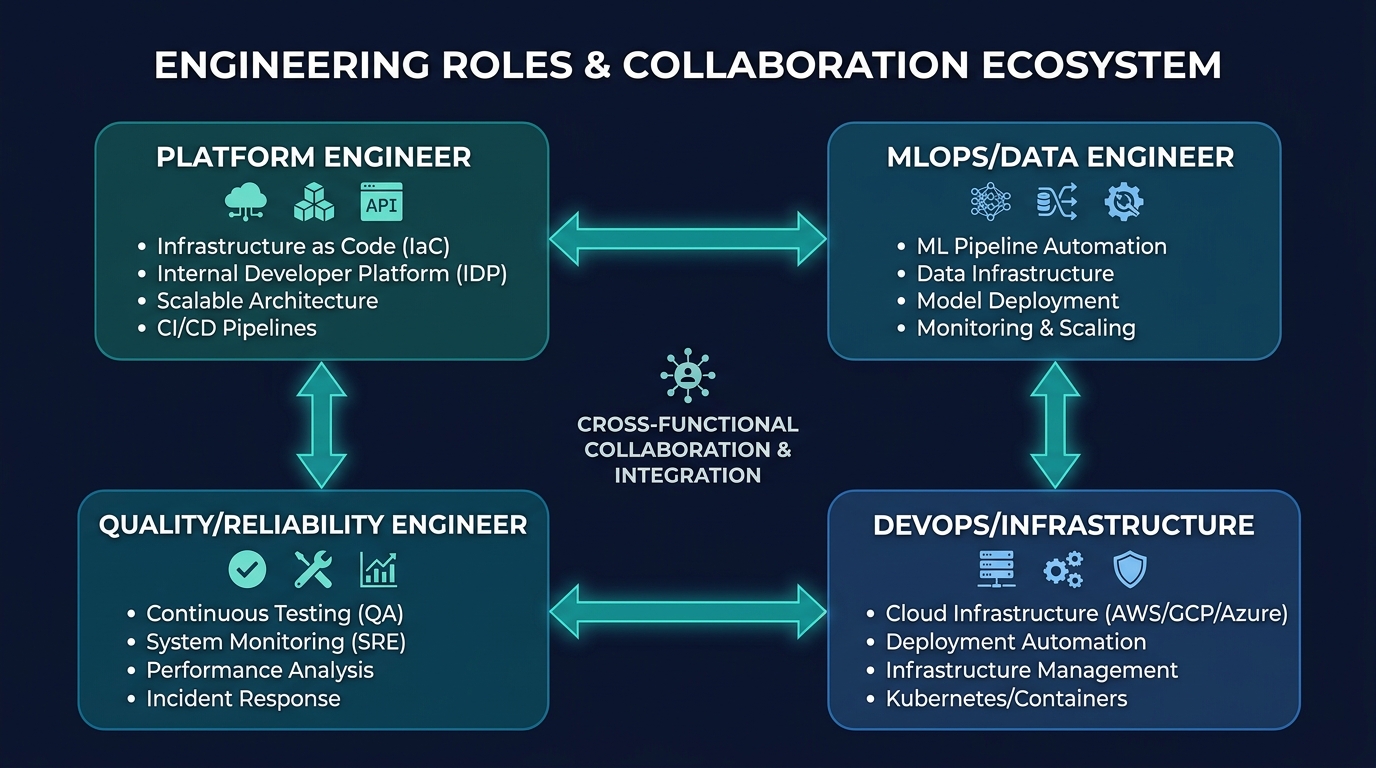
Most AI teams are built for research. They staff data scientists and ML engineers, invest in compute, and measure success by model performance. Production-ready product engineering requires four additional roles that rarely appear on an AI team org chart.
Platform Engineers
Platform engineers own the architecture that makes AI reproducible at scale. Their job is to build the systems other engineers use to build: model registries, feature stores, deployment pipelines, and environment standardization. Without this layer, every pilot-to-production transition is a manual, fragile, one-off effort. With it, each subsequent deployment takes weeks instead of months.
Platforms like NVIDIA AI Enterprise, Google Vertex AI, and Databricks have made this layer more accessible. NVIDIA orchestration can increase GPU availability for data scientists by up to 10x. But the platform still needs engineers who own it, not just consume it.
MLOps and Data Engineers
Data preparation consumes 50–70% of project resources in organizations with high production success rates. This reflects a team that understands where failures actually originate.
MLflow, the standard for model lifecycle management deeply integrated into Databricks, gives teams experiment tracking, model versioning, and reproducible deployment pipelines. Without MLOps discipline, you are shipping models you cannot roll back, cannot audit, and cannot improve systematically. Organizations using structured MLOps frameworks saw median time-to-production fall from 11 months in 2024 to 4.2 months in 2026. That is the operational value of the role.
DevOps and Infrastructure Engineers
AI systems are operational systems. They need uptime SLAs, cost budgets, incident response playbooks, and infrastructure that scales without surprise bills. This means DevOps engineers who understand both traditional reliability engineering and the specific failure modes of ML systems: model drift, latency spikes under load, and data pipeline failures that do not surface as obvious errors.
Quality and Reliability Engineers
Observability for AI in production is not the same as observability for traditional software. Silent drift - where a model degrades without throwing an error - is the failure mode most teams discover too late. Quality and reliability engineers establish semantic tracing, real-time monitoring, alerting thresholds, and incident response runbooks before a system goes live. Not after the first outage.
Five-Phase Maturity Framework: From Value to Governance
The organizations that consistently ship AI to production use structured frameworks. Not because frameworks are magic, but because they force explicit decisions at each stage instead of letting implicit assumptions accumulate until production.
Phase 1 - Value
Tie the use case to a measurable business outcome: a specific metric, a target number, and a timeline, not just "improve efficiency." If you cannot answer this before writing a line of code, the pilot will never survive the transition to production because there is no business case to fund the operational work.
Phase 2 - Operations
Are monitoring, alerting, and continuous improvement in place before launch? This is the phase most teams skip. They treat operations as something to figure out after the model is working. In practice, "after the model is working" never arrives. The team moves to the next pilot, and the first one drifts silently in production until it fails visibly.
Phase 3 - Organization
Assign a single accountable owner, sustained funding, and cross-disciplinary alignment. This means one named person whose performance is measured by whether the system delivers business value, not a steering committee. Without this, ownership diffuses at the handoff from engineering to business operations, and the initiative loses funding at the first budget cycle after the pilot ends.
Phase 4 - Integration
Is the system embedded in real business workflows, or does it run in parallel? 95% of generative AI pilots yield no measurable business impact, largely because they automate tasks that exist alongside the actual business process rather than replacing or redesigning it. Integration means the AI system changes how work gets done, which requires close partnership with operations, legal, and IT governance, not just the engineering team.
Phase 5 - Governance
Are auditability, risk management, and compliance actively managed? The NIST AI Risk Management Framework provides the most actionable structure for US organizations. The EU AI Act adds binding obligations for high-risk systems. Governance at this phase means documented data lineage, versioned model artifacts with rollback capability, incident logs from day one, and a named human accountable for each deployed system. Only 23% of organizations have scaled agentic AI to production. Governance gaps are a primary reason the number is that low.
Building the Right Processes: MLOps, Observability, and Cross-Team Accountability
Getting the org chart right is necessary but not sufficient. The processes that connect those roles are where most organizations continue to underinvest.
CI/CD and Automated Testing
Every pilot that requires manual heroics to deploy is a pilot that will never deploy twice. Standardized CI/CD pipelines - including automated testing for data quality, model performance regression, and integration with downstream systems - are what convert one-off pilot deployments into repeatable production engineering. Databricks, NVIDIA AI Enterprise, and Google Vertex AI all enforce this as integral to the deployment lifecycle, not an optional add-on.
Advanced Observability
Traditional application monitoring catches errors. AI production monitoring needs to catch drift: a model that still runs but whose outputs are degrading in ways that do not surface as exceptions. This requires semantic tracing frameworks built on standards like OpenTelemetry, real-time output distribution monitoring, and automated alerts when model behavior diverges from baseline. Without this layer, post-deployment drift is invisible until it becomes a business incident.
Cross-Silo Ownership and Governance from Day One
The entrenched failure pattern in enterprise AI is the centralized AI lab with unclear handoff to business units. The team builds something impressive, presents it to a business stakeholder, and then discovers that "handoff" requires integrating with systems the lab team has never touched, obtaining approvals from functions that were not in the room, and operating infrastructure the lab team does not own. The initiative stalls.
The fix is to assign a single accountable owner for each AI initiative from day one - one person, not a team or governance committee - and to include that person operational stakeholders in the build process, not the review process. This also means embedding governance early: data lineage tracking, audit trails, and risk measurement need to be built into the pipeline, not retrofitted before a compliance review.
Common Mistakes That Trap Organizations in Extended Pilots
Most of these patterns are predictable. That does not make them easy to avoid, but it does mean you can design against them deliberately.
Overengineering on Day One
The impulse to build for enterprise scale before proving the business case is understandable. Technical teams want to avoid rework. In practice, overengineering at the pilot stage creates systems too complex to hand off, too expensive to operate, and too rigid to adapt when the actual business requirements turn out to differ from the assumed ones. Prove the case first. Build for scale second.
Skipping the Ops Layer
Treating AI as a research project means treating every incident as a surprise. Research projects do not have pager rotations, error budgets, or SLA commitments. Production systems do. The moment an AI system starts influencing real business decisions or customer-facing outcomes, it needs to be operated like an operational system. That means incident response runbooks, on-call rotations, and postmortem processes before the first outage, not after.
Isolated Engineering Teams
Central AI labs can be valuable for rapid experimentation. They become a liability when they operate as the permanent home for production AI systems with no clear handoff mechanism. Integration complexity - legacy systems, organizational silos, and incomplete automation - means AI agents that live in labs often remain isolated, unable to effect change at scale. The fix is embedding AI engineers directly with business unit teams for anything moving toward production, with the central lab serving as a center of excellence and toolchain owner rather than a delivery organization.
Vendor Lock-In Without a Governance Fallback
Closed-source models and SaaS APIs introduce price, continuity, and compliance risks that many organizations underestimate during procurement. 89% of large companies now use open-source models or frameworks, achieving 25% higher ROI on average versus closed-source stacks. Hybrid architectures - pairing open-source foundations with proprietary tools for specific capabilities - are the emerging standard. Whatever your stack, ensure you have a rollback path and documented governance for each model in production.
Data and Workflow Readiness: The Foundation Most Teams Underestimate
No product engineering function ships AI reliably without confronting data readiness directly. Most model failures in production trace back to fragmented, outdated, or contradictory data - not to model architecture choices.
The organizations that consistently succeed dedicate 50–70% of project resources to data preparation, access, and quality before modeling begins. That figure surprises most engineering leaders the first time they see it. It should not. Data preparation at that level is not a failure of efficiency - it is the operational work of building a system that will function under real-world conditions.
Real-world datasets are rarer than most AI teams expect. Continuous, multimodal, production-representative data is genuinely hard to acquire and maintain. Platforms like Rwazi (which launched enterprise-grade AI Datasets in March 2026) exist specifically because enterprise dataset scarcity is a persistent problem, not an edge case.
Workflow redesign is the harder conversation. Lasting business value from AI comes from re-engineered processes, not from automating tasks that exist inside a broken process. This requires close partnership with operations, legal, and compliance functions - teams that are often brought in late, if at all. Bringing them in at the design stage, not the review stage, is a product engineering discipline as much as a political one.
Measuring Product Engineering Success: Beyond Model Accuracy
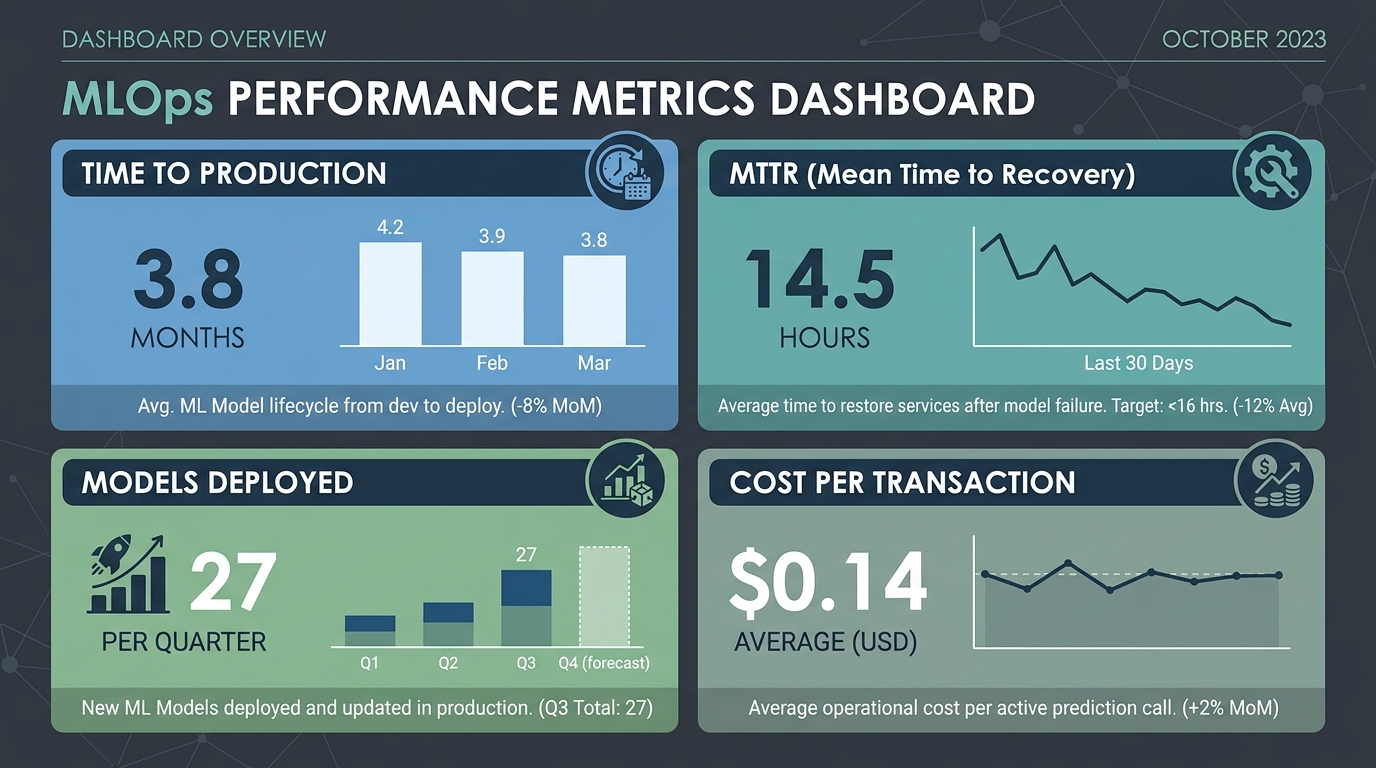
Model accuracy is a research metric. Product engineering teams need production metrics that connect engineering decisions to business outcomes.
Time to Production
Track from validated use case to stable, monitored system in production. The target benchmark, based on 2026 data for organizations using structured frameworks, is sub-4-month cycles. Anything longer suggests process bottlenecks - usually in data access, governance approvals, or environment standardization - that compound across every subsequent initiative.
Reliability and Incident Response
Mean time to recovery (MTTR), uptime SLAs, and error budgets are the core operational metrics. These numbers tell you whether your production AI system is being operated with the same discipline as your business-critical applications - or whether it is running on informal heroics. Platforms like NVIDIA AI Enterprise, Databricks, and Vertex AI provide production dashboards for observability and cost tracking, but the metrics only matter if someone owns them.
Capability Velocity
How many models are in production? How many new use cases shipped per quarter? What business value was realized - measured in revenue influenced, cost reduced, or headcount equivalent automated? Global enterprise AI spending reached $247 billion in 2026, and the generative AI segment grew 45% year-over-year to $91.57 billion. Budget is not the constraint for most organizations. Capability velocity is.
Cost per Transaction
Infrastructure and platform choices that look economical at pilot scale frequently become the dominant cost driver in production. Cost per transaction, resource utilization rates, and total cost of ownership per deployed model need to be tracked from the first production deployment. Without this discipline, AI initiatives tend to grow in resource consumption faster than they grow in business value - and eventually face budget cuts that kill the program.
Structuring Global Capability Centers for Reliable AI Delivery
GCCs add execution risk to an already complex delivery challenge. Rapid headcount expansion through staffing partners - without investing in process provenance, toolchain standardization, and governance infrastructure - is how organizations end up with distributed teams that produce inconsistent outputs and cannot collaborate across geographies effectively.
The platform modernization strategy that works for co-located teams needs additional scaffolding for GCCs: consistent codebase standards, shared deployment automation, and real-time feedback loops that tie GCC engineers to measurable outcomes rather than ticket velocity.
Winning GCC models pair headcount expansion with embedded training, mentorship from senior engineers, and direct accountability for production systems. The engineers in Chennai or Krakow who own a production AI system behave differently than the engineers who are handed tickets and asked to close them. Ownership is the operative variable.
Databricks, NVIDIA AI Enterprise, and Google Vertex AI all publish production-ready blueprints specifically designed for distributed teams - standardized toolchains, deployment automation, and governance controls that reduce the coordination overhead of operating across time zones and organizational boundaries.
The choice is not between a small team that ships and a large team that does not. It is between teams organized around ownership and outcomes, and teams organized around headcount and activity. Global scale makes the distinction more consequential, not less.
Conclusion
The enterprises that close the pilot-to-production gap are not the ones with the best models or the largest AI budgets. They are the ones that built product engineering functions capable of shipping, monitoring, and improving AI systems with the same discipline they apply to their most critical operational software. That function does not emerge from a consultant roadmap or a staffing firm placement. It gets built deliberately - role by role, process by process, metric by metric.
Key Takeaways
- The pilot-to-production gap is structural, not technical - fragmented data, unclear ownership, and immature processes are the root causes, not model quality.
- Production-ready AI requires four roles missing from most AI teams: platform engineers, MLOps and data engineers, DevOps and infrastructure engineers, and quality and reliability engineers.
- The five-phase maturity framework (Value, Operations, Organization, Integration, Governance) forces explicit decisions at each stage instead of letting assumptions accumulate.
- 50–70% of project resources should go to data preparation in organizations with high production success rates - this is operational discipline, not inefficiency.
- Production metrics matter more than model accuracy: time to production, MTTR, capability velocity, and cost per transaction connect engineering to business outcomes.
- GCCs succeed when engineers own production outcomes, not tickets - the choice is between teams organized around ownership and teams organized around headcount.
Hiring Insights 2026
The strategic shifts reshaping how enterprises source, build, and deploy talent in a capability-driven market.
GCCs and Their Impact on Hiring
How Global Capability Centers are rewriting the rules of talent acquisition, workforce planning, and organizational design.
Talent vs. Opportunities
Why the traditional talent market is inverting and what enterprises must do when opportunities outnumber the people who can deliver them.
The Big Picture of GCCs in AI-Driven Businesses
How Global Capability Centers are becoming the AI-powered engines of enterprise transformation - and what it takes to build one that matters.
Zero Trust Architecture: An Enterprise Guide
Why "never trust, always verify" has become the foundational security model for modern enterprises and how to implement it without paralysing your business.
Ransomware Protection Strategies for 2026
How ransomware has evolved from opportunistic extortion to industrialised crime and the defence-in-depth strategies enterprises need to survive.
Cloud Security Misconfigurations: The Silent Threat
Why the most common cloud breach is not a hack but a misconfiguration and the governance, tooling, and culture that prevents it.
AI in Cybersecurity: Threats, Defences, and the New Battlefield
How artificial intelligence is arming both attackers and defenders and why the organisation that integrates AI into security first will win.
Building a Cybersecurity Capability from Scratch
A practical framework for enterprises that need to move from ad-hoc security tools to a structured, staffed, and sustainable security function.
Why Trusted AI Is the Need of the Hour
As AI moves from pilot to production, trust is becoming the single factor that determines whether AI delivers value or creates catastrophe. Here is why trusted AI is no longer optional and what enterprises must do to build it.
Platform Modernization: From Pilot to Production
Why 80–95% of enterprise AI pilots never reach production - and the architectural, governance, and operational changes that close the gap.
The Roadmap Handoff Problem: Why Strategy Alone Fails
Why transformation leaders need partners who stay accountable from strategy through measurable execution.